
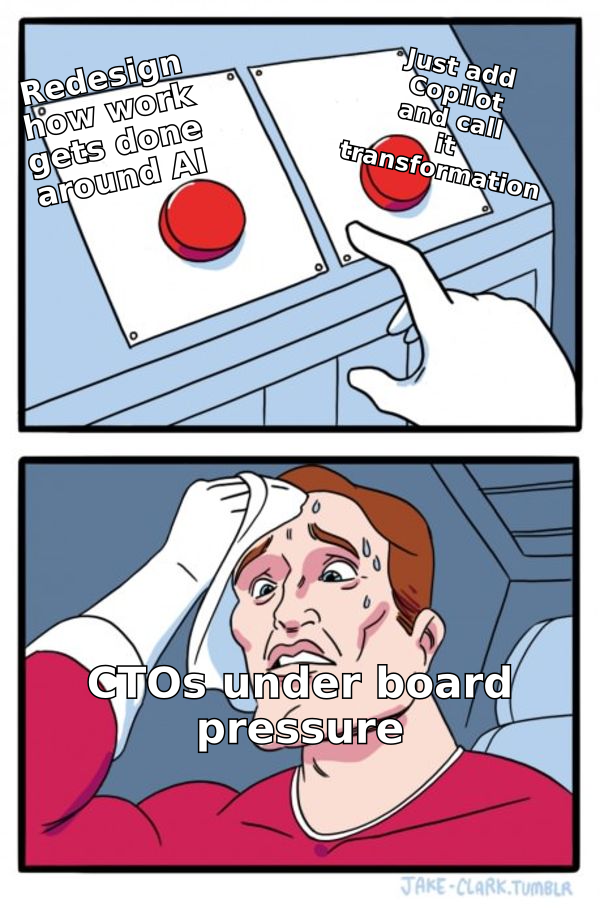
The slide read: “AI Adoption Metrics — Q3.” The CTO clicked through it with the practiced confidence of someone who had rehearsed this at least twice. Licenses deployed: 4,200. Active monthly users: 61%. Queries per week: up 340% quarter-over-quarter. The board nodded. A few smiled. One venture partner in the back wrote something in a notebook.
Six months later, the CFO opened the Q4 operating review with a different kind of question. The headcount hadn’t moved. The output per employee hadn’t moved. The gross margin was flat. The AI spend line had grown 40%. “Help me understand,” she said, “where the productivity is.”
This is not a hypothetical. It is, at this point, a pattern.
The Deployment Trap
Deloitte’s 2025 State of Generative AI in the Enterprise found that 48% of organizations have deployed AI tools without meaningfully redesigning the workflows those tools sit within. Only 12% have achieved what Deloitte calls “work redesign at scale.” The rest are somewhere in between: using AI, getting some efficiency at the individual level, and watching enterprise-level productivity improvements fail to materialize on the P&L.
This is not a technology failure. The models work. The tools work. Copilot does what Copilot says it does. The failure is organizational — and it’s a failure of imagination about what adoption actually means.
Layering AI on top of pre-AI process maps captures a fraction of the available value. It’s the equivalent of giving a horse-drawn carriage team a car and telling them to keep following the same roads, at the same stops, in the same sequence. The car is faster. But you haven’t rethought the route.
What Adoption Metrics Actually Measure
Usage data tells you how many people opened the tool. It does not tell you whether the tool changed how the work gets done. These are different questions, and conflating them is exactly how a 61% active user rate becomes invisible on a productivity dashboard.
The questions worth asking — and that most leadership teams are not asking — are different in character. Not “are your employees using Copilot?” but: Have you rethought how decisions get made? Have you changed how work gets handed off between teams? Have you redesigned how outputs get reviewed and approved? Have you eliminated any of the coordination overhead that AI could make irrelevant?
If the answer to most of those is no, you have not deployed AI. You have deployed a better autocomplete. That’s worth something. It’s not worth what you paid for it, and it is absolutely not the competitive moat you’re presenting to your board.
What Workflow Redesign Actually Requires
At the VP and director level, workflow redesign is not a technology project. It is a process archeology project followed by a political negotiation.
The archeology: mapping what work actually looks like, step by step, decision by decision. Not the RACI chart. Not the org chart. The real flow — who touches what, in what order, why, and with what friction. Most senior leaders have not done this in years, and many have never done it at this level of granularity. That’s not a criticism; it’s the division of labor that comes with scale. But if you want to find where AI changes the unit economics of a process, you have to know what the process actually is.
The negotiation: redesigning workflows means invalidating some of the work people are currently paid to do. It means collapsing handoff steps that were built around human latency. It means questioning the review cycles that exist because someone, years ago, didn’t trust the output quality at an earlier stage. Some of that distrust is still warranted. A lot of it isn’t. Deciding which is which is uncomfortable, and it requires political capital most leaders would rather spend elsewhere.
That’s the bottleneck. Not the AI. Not the data. The willingness to have a conversation about which of your existing processes were designed around constraints that no longer exist.
The Three Places Value Goes Missing
The gap between “AI deployed” and “AI generating enterprise value” shows up most consistently in three places.
Review cycles that didn’t shrink. AI generates a first draft. A human reviews it. Another human approves the review. A third human signs off on the final. If the review cycle was built for a world where first drafts were produced by junior employees working under deadline pressure, it was calibrated for a certain error rate. AI first drafts have a different error profile. The review process should change accordingly. It almost never does, because changing it requires trusting that AI outputs are different — not just faster — from human outputs.
Coordination overhead that got automated in the wrong place. The most common AI use case in enterprise settings is summarization: meeting summaries, email digests, status update drafts. These are real productivity gains at the individual level. But they also raise a question nobody is asking: why does your organization generate that much content that needs to be summarized? Automating the summary doesn’t fix the meeting culture. It makes the meeting culture more comfortable to maintain.
Headcount decisions that never got made. The most honest version of this: if AI is genuinely doing work that humans were doing, and the enterprise value is real, something else has to be different — either you need fewer people to do the same work, or those people need to be doing higher-value work. Both require deliberate decisions. In most organizations, neither is happening. People are doing what they always did, plus some Copilot usage, and no one has changed what the team is optimized to produce.
The Redesign Conversation Nobody Wants to Have
The companies at 12% — the ones achieving workflow redesign at scale — share a common characteristic: leadership that was willing to invalidate its own processes. Not incrementally. Not at the margins. They looked at how work got done and asked, “If we were designing this from scratch, knowing what AI can do, what would we build?”
That’s a different question than “how do we add AI to what we have.” And it produces different answers.
It means some teams got restructured. It means some roles got redefined. It means some processes that were considered core competencies turned out to be coordination overhead that had been mistaken for strategy. That’s uncomfortable to discover. It’s more uncomfortable when a competitor discovers it first.
What the Board Should Actually Be Asking
If you’re in a board meeting and an executive presents AI adoption metrics, the question isn’t whether the numbers are good. The question is whether those numbers are connected to anything that changes how the business runs.
A few worth asking: Which specific workflows have been redesigned since AI deployment, and what is the pre/post comparison on cycle time or output quality? Where has AI changed a hiring decision — either by not backfilling a role or by shifting what a new hire needs to be good at? What processes does this organization have today that exist because of pre-AI constraints, and who is responsible for deciding which ones to eliminate?
These questions feel uncomfortable in a room that just celebrated 340% query growth. That discomfort is information.
The Actual Competitive Divide
The companies that will own the productivity gains of this decade are not the ones that deployed AI fastest. The deployment window for competitive differentiation through tool access is already closing — the tools are commoditizing faster than organizations can absorb them.
The differentiation is organizational. It belongs to the companies willing to look at their own process maps and say: these were built for a different world, and we are going to rebuild them. That requires a kind of institutional self-confidence that doesn’t show up in adoption dashboards. It shows up, eventually, in gross margin.
The CTO who presents great usage metrics to the board but can’t explain what changed about how work gets done is playing a different game than the CFO who is watching the P&L. The gap between those two conversations is exactly where enterprise AI value goes to die.