
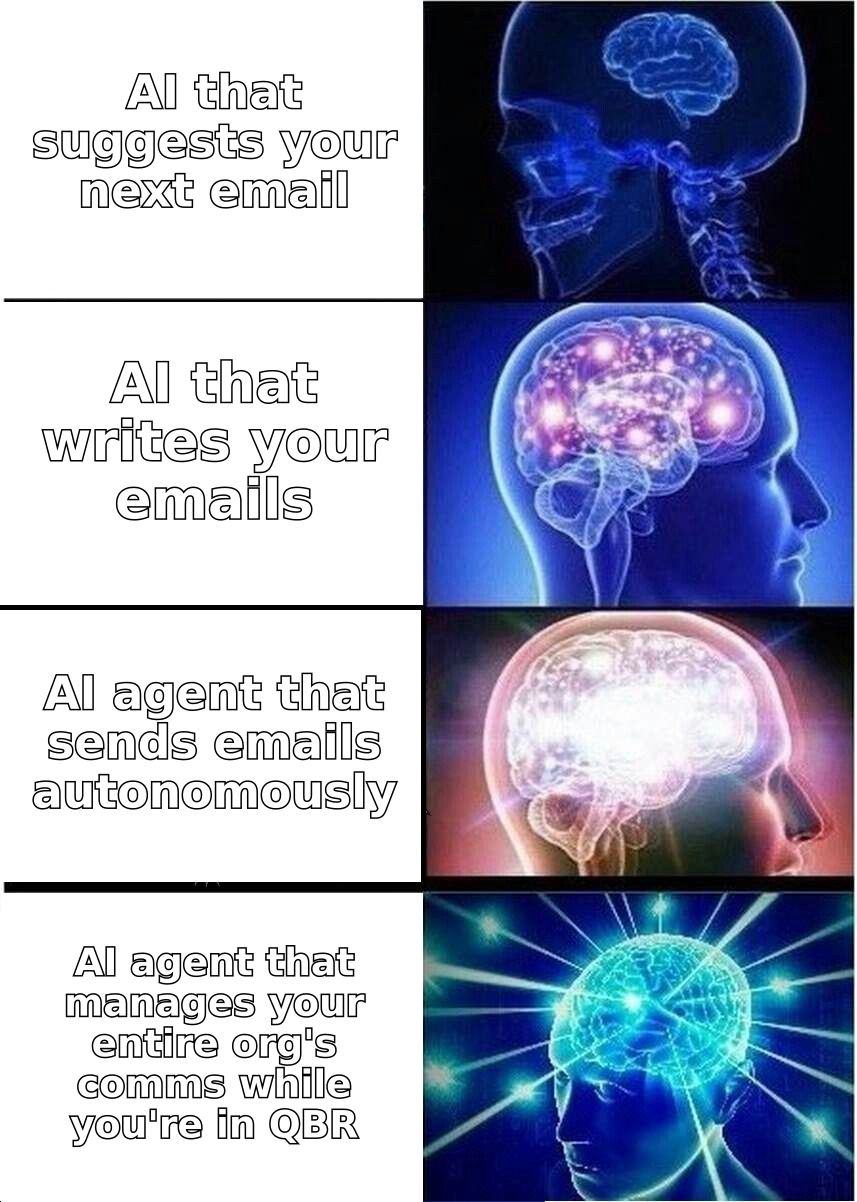
She was in the middle of a quarterly business review — the kind where the slides are tight, the questions are pointed, and the attendance is mandatory — when the notification came through. Not an alert. A Slack message from the AI agent her team had configured three weeks earlier.
It had opened a pull request. Run the test suite. The tests passed. It merged the branch. It deployed to staging. All while she was explaining sprint velocity to a room full of people who wanted to talk about roadmap prioritization.
She screenshot the Slack thread and sent it to her CTO with no caption. He replied with a single emoji. Neither of them had a word yet for what had just happened, or whose decision it was, or what they would do if it had gone wrong.
The Actual Difference Between Copilots and Agents
The framing of AI as a “copilot” has been enormously useful for adoption. It’s approachable. It implies a human in the seat, hand on the controls, AI assisting. It maps cleanly onto existing mental models of software and autonomy.
It is also, increasingly, wrong.
Agents don’t suggest. They act. They call APIs. They write to databases. They send messages, create records, trigger downstream workflows, and make decisions based on context you gave them once, in a system prompt, weeks ago. The difference isn’t speed — it’s the presence or absence of a human checkpoint between input and consequence.
Copilots give you a draft. Agents execute the process. That is a categorically different kind of system, and most organizations have not yet internalized what that means for how they build, deploy, and govern AI.
What Agentic Systems Actually Look Like in Practice
In the last 18 months, agentic AI has moved from demo to production across a surprisingly wide range of enterprise functions. The patterns showing up most frequently: customer support agents that don’t just suggest responses but close tickets, update CRM records, and issue refunds. Code agents that not only write code but run tests, open PRs, and in some configurations, merge on green. Research agents that query internal databases, synthesize findings, and populate documents without human prompting at each step. Procurement agents that process invoices, match against purchase orders, and route exceptions — autonomously, at scale.
These are not hypotheticals. They are production systems running in organizations that deployed them because they moved fast and the ROI math was obvious. What’s less obvious, and what those organizations are now reckoning with, is the governance architecture they didn’t build before they shipped.
The Accountability Gap Nobody Planned For
Here’s the problem that emerges at scale: who owns an agent’s decisions?
With a copilot, the answer is easy. The human who accepted the suggestion. The accountability structure is clear because there is a human approval step at every meaningful juncture. The AI made a recommendation; the human made the call.
Agents break this. When an agent autonomously closes a customer ticket, issues a refund, and marks a case resolved — all in 90 seconds, without a human review — and that resolution turns out to be wrong, the accountability question gets complicated. Is it the engineer who wrote the agent? The product manager who defined the success criteria? The VP who approved the deployment? The CISO who didn’t catch that the agent had write permissions it shouldn’t have had?
Most organizations have not answered this question. Many haven’t asked it. They’ll ask it after the first incident, which is a more expensive time to discover that nobody owns it.
The Governance Gap: Copilot Policies Don’t Cover Agents
This is worth saying plainly: the AI policies most enterprises built in 2023 and 2024 were written for copilots. They cover data privacy (don’t paste customer PII into ChatGPT), model selection (approved tools list), and acceptable use (no code with proprietary logic in external systems). These are real concerns. They’re also insufficient for a world where AI systems are taking actions with real-world consequences.
Agent governance requires a different posture. The questions are different: What permissions does this agent have, and who approved them? What is the scope of its authority — can it send messages externally, write to production systems, trigger financial transactions? What is the audit trail for its actions, and where does that trail live? What is the escalation path when it encounters something outside its defined parameters? What happens when it takes a wrong action at 2 AM on a Saturday, and who gets paged?
These are not theoretical questions. They are operational requirements. And most organizations don’t have answers yet.
Tool Permissions and the Principle of Minimal Agency
The cleanest framework emerging from organizations that are getting this right is something analogous to the principle of least privilege — call it minimal agency. An agent should have exactly the permissions required to do its job, no more, and those permissions should be reviewed and approved with the same rigor as production access for a human engineer.
This sounds obvious. It is rarely practiced. Agents are often deployed with broad permissions because broad permissions make them more capable, and capability is what gets demoed in the QBR. The constraint comes later, usually after an incident forces the question.
Approval gates matter too. Not every agent action needs a human checkpoint — that defeats the purpose — but consequential actions should have defined thresholds. An agent that can read and summarize should have a different gate than one that can write and publish. An agent that can route internally should have a different gate than one that can send external communications. Defining those thresholds before deployment is governance. Discovering them after an incident is cleanup.
The Emerging Role of Agent Owner
Forward-looking engineering organizations are creating something that doesn’t exist on most org charts yet: the agent owner. Not the model. Not the platform. The specific agent running in production, with specific tools and permissions, serving a specific business function.
The agent owner is responsible for what the agent does. They define its success criteria. They review its audit trail. They own the escalation path when it fails. They decide when it needs to be updated, constrained, or shut down. They are accountable to the business for the consequences of the agent’s actions in the same way a product manager is accountable for a product’s behavior.
This role is emerging organically in organizations that are actually running agents in production and discovering that diffuse accountability produces bad outcomes. It hasn’t yet been formalized in most places, which means it’s happening ad hoc — the engineer who built it, the PM who owns the workflow, whoever happens to be on call when something breaks.
Structuring Teams Around Autonomous Systems
Agentic AI is going to require some reorganization of how engineering and product teams think about ownership. The traditional model — a team owns a product, a product has features, features are built and maintained by engineers — doesn’t map cleanly onto a world where some of the “features” are autonomous systems making real-time decisions.
What’s emerging is a distinction between agent builders (the engineers who create and maintain agents), agent operators (the owners who define the agents’ parameters and are accountable for their outputs), and agent overseers (the governance function that sets policy, manages permissions, and owns the audit infrastructure). In smaller organizations, these roles collapse into fewer people. At scale, they need to be distinct, with clear handoffs and clear accountability.
This is not complexity for its own sake. It’s the organizational architecture that makes it possible to answer the accountability question before an incident forces you to answer it under duress.
The Question the Org Chart Can’t Answer Yet
The Head of Engineering whose agent auto-deployed to staging while she was in a QBR got lucky. The deployment was clean. The PR was right. The tests were valid. The story became a Slack highlight rather than an incident report.
But the org chart doesn’t have a box for “agent accountability” yet. And that gap is closing fast — not because someone built a better governance framework, but because agents are shipping faster than the governance is. Every autonomous system that goes into production without a defined owner, without audit infrastructure, without a clear escalation path, is a liability that hasn’t been priced yet.
The leaders who will be ahead of this aren’t the ones waiting for a governance framework to arrive from legal or compliance. They’re the ones who decided, before the next agent shipped, who was responsible for what it did — and built the org structure to make that accountability real.