The AI Content Loop: Machines Write It, Machines Read It — So What Are You Actually Investing In?
 Inigo Forge
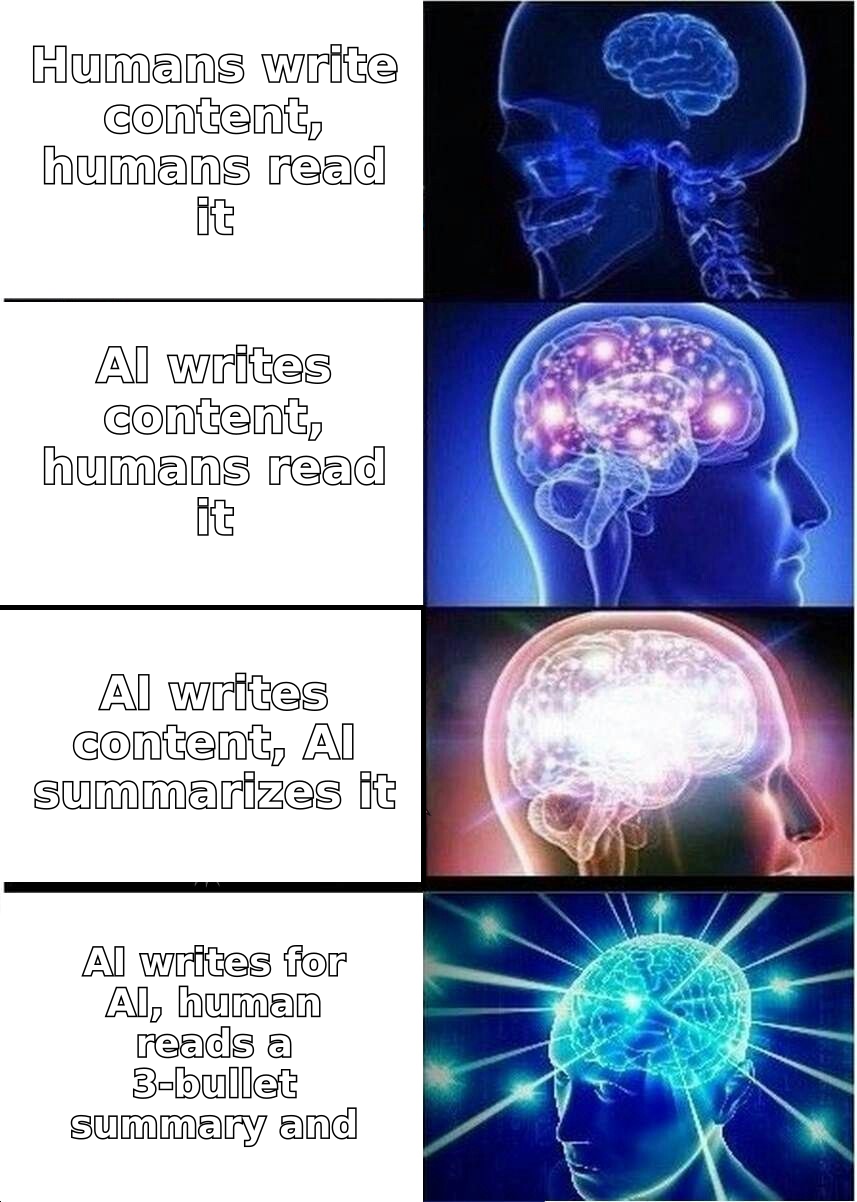
The VP of Content sat across from the CMO in the Thursday afternoon pipeline review. She had numbers. Good ones, technically. AI-generated articles were up 340% quarter-over-quarter. Publishing cadence: daily. Organic impressions: climbing. Cost per word: a rounding error.
The CMO leaned back. “And what’s the average read time?”
Silence. Then: “AI summaries are getting picked up by Perplexity, Google’s AI Overviews, and our own product’s chatbot.”
“So… machines are reading the content we’re paying machines to write?”
She didn’t answer. Because yes. That was exactly it.
The Loop Nobody Wanted to Name
Somewhere between 2023 and now, content strategy quietly crossed a threshold that almost nobody in a boardroom has said out loud: the primary consumer of AI-generated content is no longer human.
Your blog posts get indexed. AI Overviews scrape them. Perplexity surfaces a three-sentence distillation. NotebookLM turns your whitepaper into a podcast summary. Your own enterprise search tool, the one you just spent $2M deploying, ingests your thought leadership pieces and returns bullet points on demand.
The human — your reader, your customer, your prospect — never touches the original. They touch the residue.
This isn’t a fringe scenario. It’s the default architecture of information consumption in 2026. And it raises a question that content strategists, CMOs, and founders need to sit with before Q4 budget discussions: if AI is writing for AI, what exactly are you investing in?
The Economics of Content Have Always Been Weird. Now They’re Absurd.
Let’s be honest about how content marketing has worked for the past decade. You wrote long-form pieces that maybe 3% of your traffic actually read beyond the first two paragraphs. You optimized for search engine algorithms — machines — not human attention spans. You built an editorial calendar that served Google’s crawlers as much as your audience.
AI-generated content didn’t create the AI-readership problem. It just exposed the pretense.
The pretense was that SEO content was for humans. It was always, partly, for machines. Google’s bots determined your rank. Google’s algorithm decided your distribution. Humans just happened to be what arrived at the end of that pipeline.
Now the pipeline has another step. Google’s AI Overview reads your AI-written article and returns a paragraph. The human reads the paragraph. Your article — 1,400 words, four subheadings, two internal links, a call to action — served as source material for a machine that produced a sentence.
The ROI math on that is something CFOs haven’t started running yet. They will.
Three Places This Actually Matters in Your Business
1. Thought Leadership Is Becoming Table Stakes, Not Differentiation
When every company in your category is publishing AI-generated frameworks, playbooks, and “definitive guides,” the signal-to-noise ratio collapses. Your VP of Marketing’s LinkedIn post about AI transformation is indistinguishable, in tone, structure, and insight, from the post your competitor published twelve minutes earlier.
AI summarizers are trained to extract the average. When the inputs are all average, the outputs are perfectly average. Your thought leadership — the thing you’re spending budget on to create differentiation — is getting homogenized at the point of consumption.
The executives who will win the thought leadership game in the next three years are the ones producing content so specific, so earned, and so rooted in proprietary context that no AI can synthesize it without losing the point.
2. Your Content Is Training Data. Act Like It.
Here’s the part that should give your legal team pause: every article you publish is now potential training data, retrieval context, or source material for a model somebody is running. Your IP, your frameworks, your named methodologies — they’re inputs to systems you don’t control.
That’s a governance conversation that most organizations haven’t started. Content strategy teams think in terms of audience and SEO. Legal thinks in terms of copyright. Neither team is thinking in terms of what happens when your corpus of published thought leadership becomes the retrieval layer for a competitor’s internal AI.
If your content is valuable enough to be scraped, it’s valuable enough to have a provenance and licensing strategy.
3. The Measurement Framework Is Broken
Pageviews, time on site, scroll depth — none of these metrics capture whether your content actually informed a decision or influenced a buyer. They were imperfect proxies when humans were reading. Now that AI intermediaries are doing the reading, they’re measuring nothing of substance.
The forward-looking metric is influence at the point of AI synthesis. Did your framing show up in the AI’s answer? Did your data get cited? Did your named methodology propagate? That’s citation influence, not click-through rate, and almost no marketing team is measuring it.
What “Content” Is Actually For, If You Step Back
Here’s the uncomfortable reframe: content was never really about the words. It was about a signal — a signal of expertise, of investment, of presence in a category. The words were just the carrier wave.
That signal still matters. But the receiver has changed.
When a VP of Engineering at a Series C company asks their internal AI assistant “what do the leading voices on AI governance say,” the answer is drawn from whoever published coherently on the topic. The human never reads the original. But the human trusts the answer. And the answer reflects who showed up.
So the question isn’t “should we keep publishing?” The question is: are we publishing things that survive the compression?
Generic AI-generated listicles don’t survive. Proprietary data does. Specific case studies do. Hard-won operational insight — the kind that requires having actually shipped something, failed at it, rebuilt it — that survives. Because an AI summarizer can compress a framework, but it can’t manufacture the authority of someone who lived through the scenario.
The Strategic Move Most Organizations Are Missing
There’s a counterintuitive play available to organizations willing to invest in it: go denser, not lighter.
The race to volume — publish more, publish faster, publish cheaper — is a race to irrelevance. You’re competing with every other company running the same content factory, all of it getting flattened into the same AI-synthesized summaries.
The durable play is the opposite. Publish less. Publish harder. Publish things that require your specific vantage point to produce. A quarterly research report based on your customer data. A post-mortem from an actual failure with actual numbers. A framework built from 200 customer interviews that only you conducted.
That’s content that survives the summarizer. Not because it’s long, but because the signal-to-noise is high enough that compressing it loses something. And when something is lost in compression, the AI-generated summary says “read the original.” That’s the goal.
The VP’s Answer
After the meeting, the VP of Content stayed back. She had an answer to the CMO’s question — she just hadn’t said it yet.
“Yes,” she said, half to herself. “Machines are reading what machines wrote. But the machine that reads us is the one our customers trust. So we’re not writing for humans to read. We’re writing to shape what the machine says.”
That’s a valid strategy. It’s just not the strategy anyone thought they were funding.
The organizations that figure this out first won’t publish less or more. They’ll publish differently. With provenance. With specificity. With the kind of density that compression can’t erase.
Because in a world where AI reads everything, the only thing that matters is whether something worth reading got in there first.