
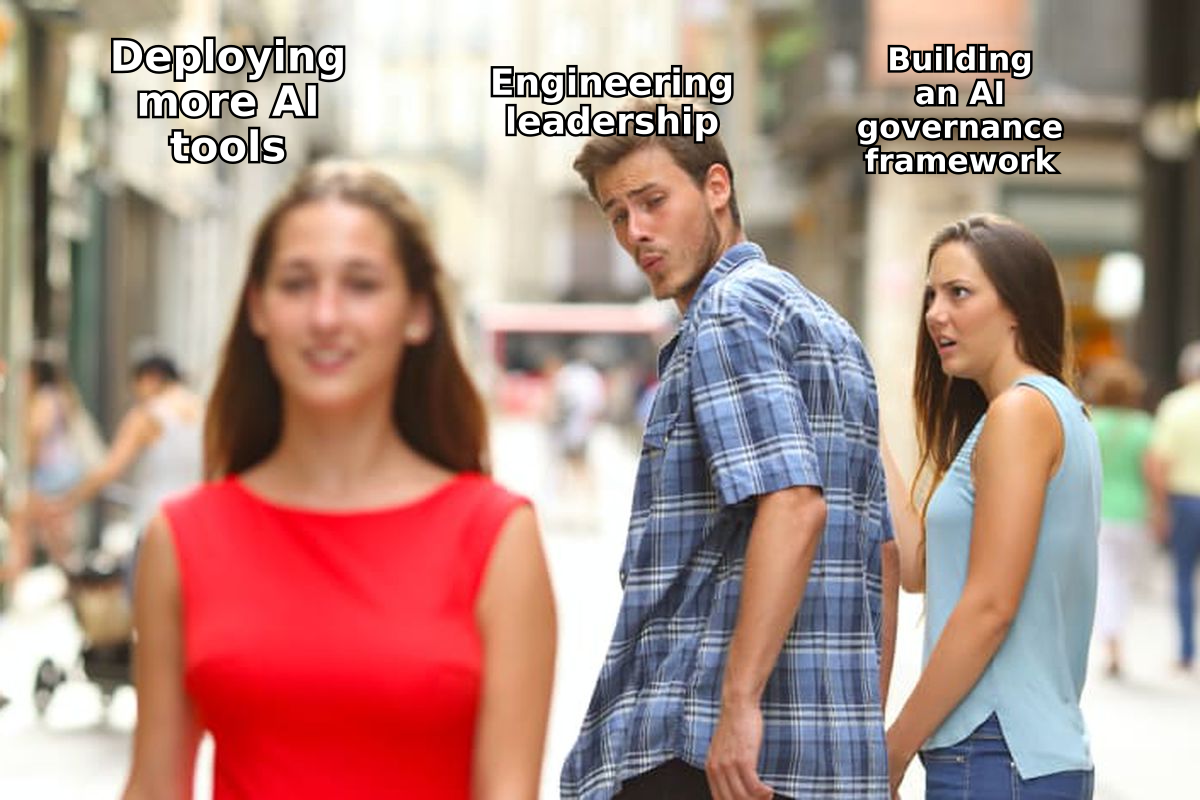
The question came from the independent director on the audit committee. She’d been quiet for most of the meeting, which was never a good sign. She waited until the agenda item on AI initiatives concluded, let the room exhale, and then asked it.
“If our AI system makes a consequential error — one that harms a customer, triggers a regulatory inquiry, or costs us materially — who in this room is accountable?”
The CTO looked at Legal. Legal looked at the CISO. The CISO looked at the CTO. The CEO looked at the table. Nobody answered in the first five seconds, which meant the question had already been answered in the worst possible way.
How Governance Arrived in the Boardroom
This wasn’t always a board-level question. AI governance started its life in the IT department, where it belonged to the people who controlled data access and model selection. Which vendors are approved? What data can we send to external APIs? Who can spin up a new model? These were infrastructure questions, and infrastructure is IT’s domain.
Then it became a compliance question, shaped by a wave of regulation that arrived faster than most legal teams expected. The EU AI Act introduced risk tiers and mandatory conformity assessments for high-risk AI systems. GDPR implications for AI-generated decisions affecting EU citizens became a live issue. Sector regulators in financial services, healthcare, and critical infrastructure started issuing guidance — some of it binding, some of it strongly suggestive. Compliance absorbed what IT had built and added a legal framework on top.
Now it’s a fiduciary question. The board of directors — specifically the audit committee and, in some cases, a dedicated technology committee — is being asked to provide oversight of AI risk in the same way it provides oversight of financial risk, operational risk, and reputational risk. This is not a metaphor. Institutional investors are asking about AI governance in proxy materials. Insurance underwriters are pricing it. Regulators are examining it in the course of broader supervisory activities.
The governance question landed in the boardroom because the consequences of getting it wrong got large enough to become board-level consequences.
The Three Governance Gaps
Deloitte’s 2025 enterprise AI survey identified three structural gaps that define where most organizations are failing on AI governance: work redesign (building AI policies around what you deployed, not what you need to govern), governance clarity (not knowing who is responsible for what), and ROI measurement (no framework for evaluating whether governance investments are delivering risk reduction relative to their cost).
The clarity gap is the one most directly visible in the boardroom. It shows up as exactly the kind of silence that followed the independent director’s question: a room full of senior people who have each done something related to AI governance and none of whom feel clearly responsible for the answer.
This is not incompetence. It’s the predictable result of governance frameworks that evolved incrementally, adding layers without clarifying ownership. IT handled access. Compliance handled regulatory mapping. Legal handled contracts. Product handled deployment decisions. Nobody ever drew a clear line from “AI system takes an action” to “this person in this role is accountable for that action.”
Who Owns Model Risk
In financial services, model risk management is a mature discipline. Banks have model risk officers, model inventories, validation frameworks, and escalation paths. The governance architecture exists because regulators required it and the consequences of model failures were visible in past crises.
Outside financial services, model risk is less formalized. Most enterprises don’t have a model inventory — a complete list of the AI models running in production, what decisions they influence, what data they consume, and who is responsible for their ongoing accuracy. They don’t have a validation cadence. They don’t have a defined process for deciding when a model needs to be retrained, deprecated, or shut down.
Filling this gap starts with a simple question nobody has asked: what AI systems are actually running in our organization right now? Not the approved deployments. Not the enterprise license agreements. The full picture — including the AI features embedded in SaaS tools, the shadow deployments that department heads approved independently, and the automation workflows that someone built with no-code tools and never formally classified as AI. The inventory precedes the governance. Most organizations don’t have the inventory.
Copilot Governance vs. Agent Governance vs. Physical AI
The governance posture that’s appropriate for a copilot (a tool that suggests, with human approval at every step) is materially different from what’s appropriate for an agent (a system that acts autonomously) or for physical AI (robotics, autonomous vehicles, AI-controlled manufacturing systems). Treating all three with the same governance framework is a mistake, but it’s a mistake most governance policies currently make.
Copilot governance is primarily about data access and output quality. What data does the model see? Is the output accurate enough to be acted on? Are there categories of content or decisions where copilot suggestions should never be applied without review?
Agent governance adds accountability and scope. Who approved this agent’s authority to take actions? What is the boundary of those actions? What audit trail exists? What is the rollback procedure? Who is paged when the agent encounters an edge case outside its parameters?
Physical AI governance adds irreversibility and safety. Some actions cannot be undone. The governance framework for a system that can affect the physical world — whether a warehouse robot, a medical device running AI diagnostics, or an autonomous vehicle making traffic decisions — needs to account for consequences that software systems generally don’t create.
An organization that builds a single AI governance policy and applies it uniformly has not built governance. It has built a document.
The Approval Path for Customer-Facing AI
One of the most common gaps in enterprise AI governance: no formal process for deciding when an AI system is ready to go into a customer-facing workflow. Pilots get run. Results get presented. Business cases get approved. Products get shipped. Somewhere in that chain, someone implicitly decided that the AI was accurate enough, reliable enough, and safe enough to interact with customers. But that decision rarely has a name, a sign-off, or an escalation path.
This matters because customer-facing AI operates at the intersection of technology risk, legal risk, and reputational risk simultaneously. A model that performs at 94% accuracy in internal testing and fails in a specific demographic segment in production is not just a technical problem. It’s a regulatory exposure, a PR crisis, and a legal liability — potentially all at once.
The organizations doing this well have built something analogous to a product approval gate specifically for AI-powered customer interactions. It includes accuracy thresholds by use case, bias evaluation across relevant demographic segments, legal review of the outputs and the decisions the AI is influencing, and a monitoring framework that flags degradation in production. It has a named owner. It has an escalation path. It is not a spreadsheet that someone updates when they remember to.
Governance as a Product Decision
The executives who are handling AI governance effectively share a frame that distinguishes them from those who are not: they treat governance as a product decision, not a compliance exercise.
The compliance frame asks: what do we have to do to avoid regulatory exposure? It produces the minimum viable policy document. It satisfies auditors. It does not produce accountability clarity, and it does not anticipate failure modes that regulators haven’t yet codified.
The product decision frame asks: what governance architecture do we need to build the AI systems we want to build, at the scale we want to operate, without creating liability that exceeds the value we’re capturing? It produces something more like an operating system for AI deployment: model inventory, deployment approval gates, agent ownership framework, audit infrastructure, escalation paths, and a named governance owner who reports to the executive team.
That frame is harder to build. It requires the CTO, GC, CISO, and Chief Risk Officer to be in the same room building something together, which is not a natural collaboration. But it’s the only frame that produces governance capable of keeping pace with AI deployment.
The Silence Is the Answer
Back to the boardroom. The independent director’s question hung in the air for long enough to be memorable. Eventually, someone said something about the governance committee working group. Someone else mentioned the CISO’s quarterly review. The conversation moved on.
But the silence was information. It told the board, and anyone paying attention, that the accountability chain for AI risk was not clear, was not documented, and was not owned by anyone in the room. It told them that if something went wrong, the cleanup would be improvised under pressure — exactly the conditions that produce the worst outcomes.
The executives who will navigate this decade’s AI transition without a major governance failure are not the ones who handed AI governance to compliance and moved on. They’re the ones who treated the silence as a problem worth solving before something forced their hand.